Opening Remarks
Keynote Remarks
.png)
September 2026
Cultural Article
Rakugo – A Whole New World
By Tomomi Dodd
Do you know Rakugo (落語)? Rakugo is an old Japanese art of comedic storytelling performed by a single storyteller. They usually do not use any props, and they portray multiple characters. Rakugo (literally "story with a fall") is a form of Japanese verbal entertainment where a lone storyteller, called a rakugoka, sits on a small raised platform (kōza) in the traditional seiza kneeling position. Without ever standing, the performer uses only a paper fan (sensu) and a small cloth (tenugui) as props to act out all the characters in the story. Character differentiation is achieved through changes in pitch, tone, and subtle head movements, while the story culminates in a punchline known as ochi, which delivers a comedic or surprising conclusion.

Rakugo traces its roots to the Heian period (794–1185), when Buddhist monks used storytelling to make sermons engaging, and evolved through the Sengoku period (1467~1615), when monks entertained feudal lords. It became a popular form of entertainment for commoners during the Edo period (1603–1868), flourishing in urban centers like Edo (modern Tokyo). Rakugo stories are divided into classical repertoire (koten rakugo) and original works (shinsaku rakugo).
Rakugo is not only a form of entertainment offering humor, satire, and social commentary, but it is also a reflection of Japanese culture and society. The skill of the rakugoka lies in evoking vivid imagery and emotion with minimal props, relying on voice modulation, timing, and gestures to engage the audience.
Though I live in the United States, recently, I had an opportunity to go watch rakugo in Washington, D.C. Surprisingly, the performer was a Canadian man called “Katsura-Sunshine”, and the performance was done in English. He is the second western rakugo comedian in history. Honestly speaking, I had never had a strong interest in rakugo until my husband invited me to this show. I grew up in a family where no one had an interest in rakugo, and my honest image about it was that it was old fashioned, difficult to understand, and that it’s for old people. However, Katsura-Sunshine and his apprentice’s performances completely changed my image about rakugo; the nature of rakugo with its complex wordplay is fun and witty, and makes great use of your imagination.
During his show, Katsura-Sunshine started talking about the word “chau” from the Osaka dialect. “Chau” typically means “it’s wrong,” but it can also mean other things depending on how you use it. Katsura-Sunshine started playing with the words “chau” and “Chow Chow,” a dog breed, as they have same pronunciation, proving that Osaka people can have a conversation using the word “chau” only.
Person 1: (Phonetically, in Japanese) “Chow Chow chau?” (By pointing at a Chow Chow.)
(English Translation: Isn’t that a Chow Chow?)
Person 2: “Chau chau!! Chow Chow chau.
(No, no!! That’s not a Chow Chow.)
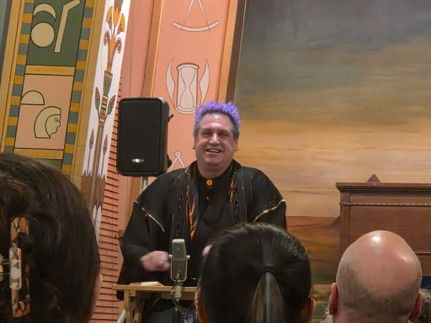
Katsura-Sunshine talked about the time when he first encountered rakugo in the following article:
“It was love at first sight. The rakugo language is older Japanese; it was hard to understand the story, but the first half (the stand-up comedy bit) is a one-man play and ends in a punchline. You can figure out the style without an explanation. I was aimless in Japan for a long time. I was still writing theater for Canada, but teaching English at university here. My work was here, but my passion was there. And then it all came together in one incredible moment, by a bolt of lightning. To think of what my life would be if I had not met rakugo. I just can’t imagine.” (Reference: 10 Questions with Katsura Sunshine, Second Western Rakugo Comedian in History | Tokyo Weekender

I highly recommend you watch rakugo either in person or online (it’s available on YouTube) at least once if you have never seen it. It will take you to a whole new world
References:
The Enduring Allure of Rakugo: Japanese Storytelling Evolved - Living Guide in Japan
10 Questions with Katsura Sunshine, Second Western Rakugo Comedian in History | Tokyo Weekender