Opening Remarks
Keynote Remarks
.png)
July 2026
Cultural Article

Tsukimi – Moon viewing
by Kotaro Yamamoto
You may be familiar with Hanami, a Japanese tradition where people gather to view cherry blossoms in the spring and enjoy meals outdoors with family and friends.
On the other hand, do you know Tsukimi? Tsuki means Moon and Tsukimi is Moon-Viewing.
Moon-viewing is a traditional Japanese custom in which people admire the moon shining in the clear autumn night sky and give thanks for the bounty of nature. In particular, the lunar calendar was used in Japan until the Meiji era; moon-viewing is generally held on the night of “Jūgoya,” the 15th day of the 8th month in the lunar calendar. In 2026, this corresponds to September 25 on the Gregorian calendar.
The reason Japanese people celebrate the Moon Viewing Festival in autumn isn’t just because the air is clear and the moon looks beautiful at that time of year. Instead, since rice is a staple food in Japan and rice farming is widespread, this tradition exists as a time to offer prayers for a bountiful harvest in the autumn, when the rice is ready for reaping.
It is said that the tradition of moon viewing on the fifteenth night of the 8th lunar month was introduced from China during the Heian period (794–1185), became popular among the aristocracy, and eventually spread to the common people during the Edo period (1600–1867).
During the Moon Viewing Festival, it is customary to display pampas grass and eat mochi rice cakes, called tsukimi-dango, arranged in a pyramid shape.
Since pampas grass resembles heads of rice stalks and mochi is made from rice, this tradition is associated with prayers for a bountiful harvest.
Now, regarding tsukimi dango, it has long been said that they are made by the rabbit that lives on the moon, as Japanese people believe that they see a rabbit pounding rice cake with a pestle when viewing the moon’s dark patterns from Earth.
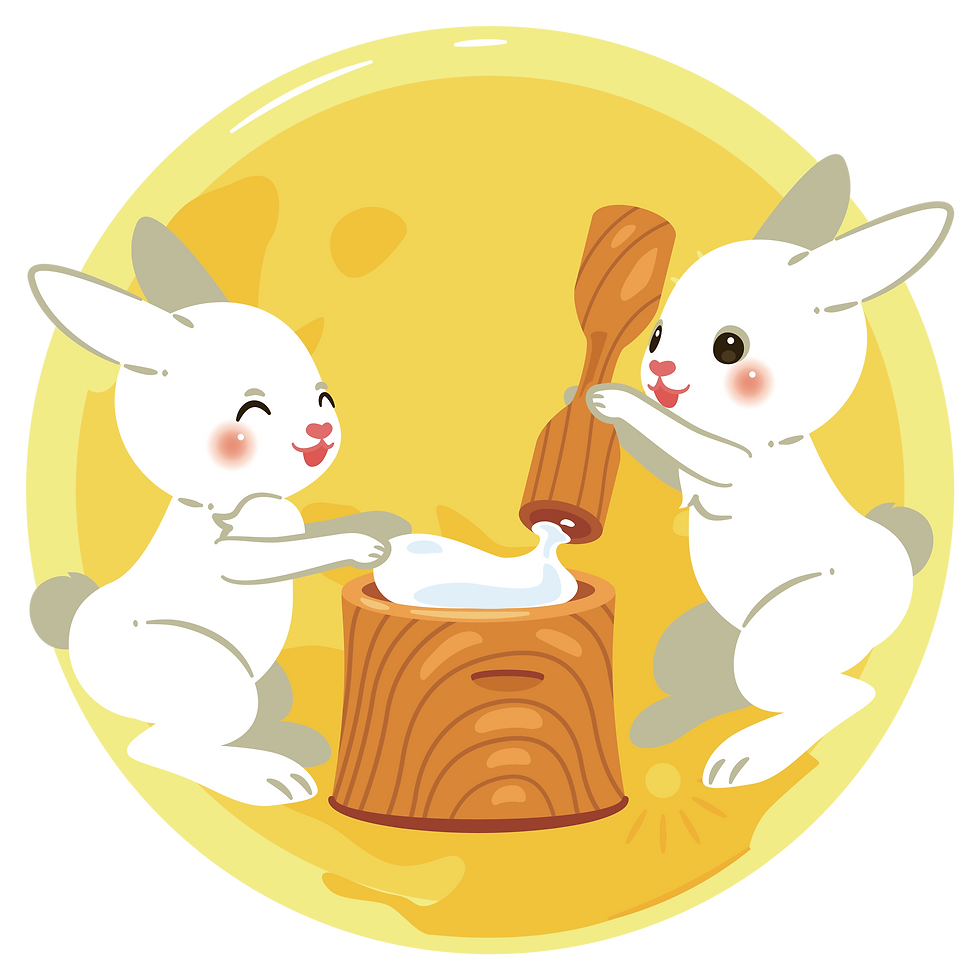
A rabbit living on the moon is a common legend throughout Asia, including India and China, but people all over the world have imagined all sorts of things in the moon’s patterns. In addition to a rabbit, these include a crab, a human profile, a crocodile, and more. In any case, it’s clear that the moon has long served as a canvas for human feeling and thought.

Academically, the prevailing theory is that the Moon was formed approximately 4.5 billion years ago as a result of a massive collision between the early Earth and a Mars-sized celestial body. For this reason, the Moon is not merely a satellite to Earth, but a special entity that can be considered an integral part of the Earth itself.
Amidst living a busy life, why not take a little time to gaze at the moon while enjoying something sweet and clear your mind? You might just discover something new.