Opening Remarks
Keynote Remarks
.png)
Navigation through the Strait of Hormuz from an International Law Perspective
By Hiroyuki Yamagami
1. Introduction
The Strait of Hormuz connects the Persian Gulf with the Gulf of Oman, and is famous as one of the most critical choke points in the world in terms of energy transport. It is estimated that about 20% of the world’s crude oil and LNG demand goes through the narrow waterway whose width is only 21 nautical miles (39 kilometers) at its narrowest point. Before the current crisis, around 140 vessels, mainly tankers, container vessels and car carriers, would pass through the strait every day in accordance with the Traffic Separation Scheme stipulated by the IMO (International Maritime Organization) with agreements by the coastal states including Iran and Oman.
For Japan, the Straight is especially important as 95% of its crude oil and 10% of its LNG is imported from Middle Eastern countries. In accordance with the Japanese Shipowners’ Association, more than 90% of the Middle East’s crude oil is transported by Japanese carriers.
The Strait has, however, been virtually impassable since the attack by the US and Israel on Iran at the end of February this year. As of mid-May 2026, more than 700 commercial vessels with 20,000 seafarers, including approximately 40 Japanese-related vessels with 1,000 seafarers, are stranded in the Persian Gulf.
This article intends to clarify the Strait’s legal status in terms of international law and the interpretation made by the concerned governments and the international community in an easy-to-understand manner.

(Image Source: https://www.freeworldmaps.net/ocean/hormuz-strait/hormuz-strait-location-map.jpg)
2. UNCLOS and the Strait of Hormuz
Under UNCLOS (the United Nations Convention on the Law of the Sea), which established a comprehensive law and order regime for the world’s ocean and entered into force in 1994, the Strait of Hormuz is recognized as a strait used for international navigation (hereinafter referred to as an ‘International Strait’).
Before elaborating on what an International Strait is, I would like to briefly introduce UNCLOS’s provisions over the sea.
Along the ocean’s surface, the UNCLOS roughly defines 4 maritime zones, from the shore to deep sea:
Inland Water (there is Coast/Base Line between (1) and (2))
Territorial Sea
Exclusive Economic Zone (EEZ)
High Seas
Please see the picture below concerning each area beyond the Coast/Baseline.
The EEZ is a relatively new concept, proposed and incorporated into the UNCLOS in the 1970s. While it is principally aimed at regulating rights over natural resources, such as fisheries and seabed resources, navigational rules of the High Seas also apply (Art.58-1). As such, rather than focusing on the EEZ or of Inland Water, this article will only touch on the Territorial Sea, the High Seas and the International Strait maritime zones.
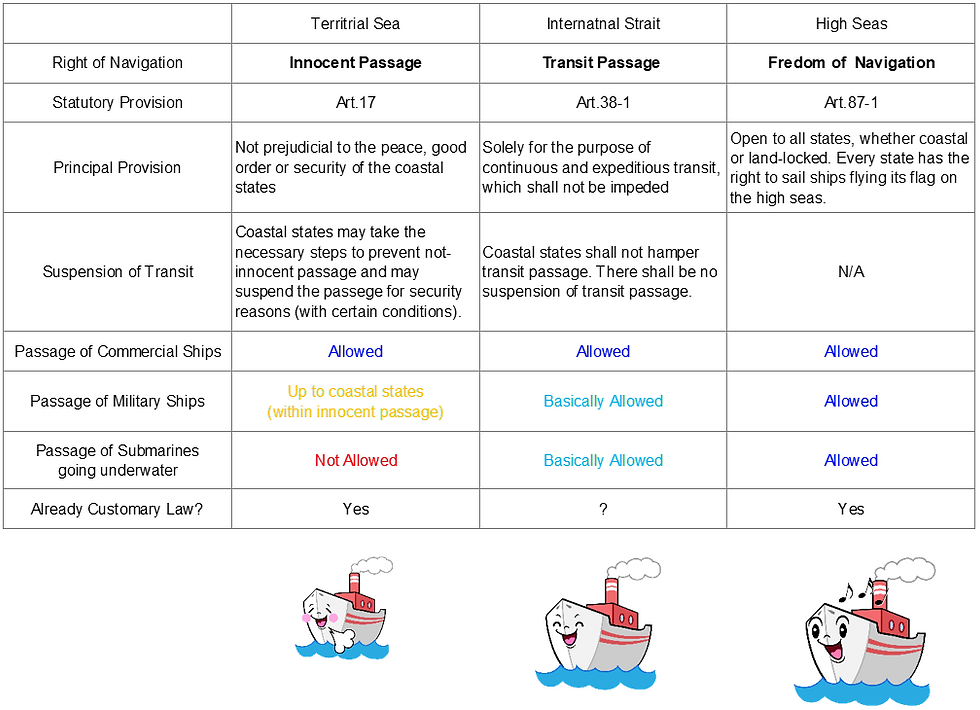
In accordance with the UNCLOS, the Territorial Sea is an area up to 12 nautical miles, measured from the Baseline (Art.3) and the sovereignty of the coastal states is basically granted over the zone. (Art.2-1) On the Territorial Sea, all ships can enjoy the right of innocent passage, which means passage which is not prejudicial to the peace, good order or security of the coastal states. (Art.19-1)
On the other hand, the High Seas are open to all states and freedom of navigation is secured in the area (Art.87, Freedom of the High Seas). Every state has the right to sail ships flying its flag on the High Seas. (Art.90)
In the meantime, the UNCLOS puts special provisions on International Straits (Art.34-), situated between the Territorial Sea (Art.17-) and the High Seas (Art.86-).
An International Strait is essentially a strait used for international navigation between one part of the High Seas or an EEZ and another part of the High Seas or an EEZ. (Art.37) Although there are several exception provisions, the Strait of Hormuz is one such International Strait, along with the Strait of Malacca and Singapore, the Strait of Dover and the Strait of Gibraltar.
In the International Strait, all ships can enjoy the right of no-impeded Transit Passage, which means the navigation solely for the purpose of continuous and expeditious transit of the strait. (Art38-2)
The Strait of Hormuz, whose minimum width is 21NM, belongs to the Territorial Sea of Iran and Oman (the median line is applied) and fully satisfies the definition of International Strait by the UNCLOS concerning the navigation as stated above.

(Image credit: U.S. Department of State as modified by NOAA to add Three Nautical Mile Line )
3. Arguments by Coastal States of the Strait of Hormuz
As mentioned in the previous section, the Strait of Hormuz satisfies the definition of International Strait by UNCLOS. However, Iran, which signed the treaty in 1982, has not ratified the UNCLOS. Iran also denies the argument that the system of International Strait has become an international customary law which may bind the non-contracting states of the UNCLOS.
Iran argues that the Iranian side extending from the median line is simply its Territorial Sea, and it has basically permitted Innocent Passage under international customary law.
Although many academics and U.S. and European governments concur that the International Strait system in the UNCLOS has become customary law, I would like to point out that several differing arguments exist, including those expressed in a separate case by the Japanese government.
Oman, the other coastal state on the Strait, is a contracting party of the UNCLOS. However, upon signing the UNCLOS, Oman declared their interpretation that while they acknowledge Art.38 (Transit Passage) of the Convention, it does not preclude a coastal state from taking appropriate measures as are necessary to protect its interest in peace and security. Oman also declared upon UNCLOS’ ratification that prior permissions would be required for innocent passage of warships. (A similar declaration was made by Iran upon its signature. However, before current events, both countries had not substantially implemented a pre-approval system for the transit of foreign military ships.)
Therefore, it can be said that both coastal states of the Strait of Hormuz do not recognize the Transit Passage stipulated in the UNCLOS, but do recognize Innocent Passage in their Territorial Sea as written, which has become international customary law.
4. Voice of International Community
As stated above, it is notable that perceptions of the legal status of the Strait of Hormuz, one of the most important waterways in the world, differ between the coastal states (Iran and Oman) and the vast majority of other countries. Nevertheless, transit of commercial vessels must not be hindered either by Innocent Passage or Transit Passage.
Through this ongoing crisis, I have felt that the international community has tactfully avoided defining the Strait of Hormuz as the Territorial Sea or International Strait. For example, the Secretary General of the IMO remarked at a France-UK summit on Freedom of Navigation in the Strait of Hormuz on April 17 that in accordance with the UNCLOS and customary international law, straits used for international navigation cannot be closed by bordering states, and any deviation from this well-established and recognized principle would set a negative precedent and severely undermine the integrity of shipping operation worldwide. (*The author of this article omitted phrase regarding the tolls to concentrate the issue on navigation.)
On the same day, the Secretary General of the International Chamber of Shipping, an industry group, released its statement that it is imperative that full freedom of navigation is respected by all parties in accordance with international law.
On April 27, the Secretary General of the IMO stated at the UN Security Council “Principle of freedom of navigation is not negotiable. Ships must be allowed to trade worldwide unhindered in accordance with international law. In accordance with the UNCLOS and the customary international law, a straight used for international navigation cannot be closed by bordering state.”
It is notable that they never use the terms International Strait, Transit Passage, Territorial Sea and Innocent Passage. They instead chose ‘strait used for international navigation’ or ‘freedom of navigation’, which is language commonly used within the wording for the High Seas in the UNCLOS.
The IMO’s Council Decisions published on March 19 stated that UN Security Council Resolution 2817 (2026) condemned any actions by Iran aimed at closing, obstructing, or otherwise interfering with international navigation through the Strait of Hormuz, or threatening maritime security in the Bab Al Mandab, and affirmed that any attempt to impede lawful transit passage or freedom of navigation in these waterways constituted a serious threat to international peace and security. It used the term of ‘transit passage’ but added the term ‘freedom of navigation’.
Three types of navigation/passage in accordance with the UNCLOS
5. Conclusion
Given that both coastal states do not fully accept the right of Transit Passage through the Strait of Hormuz, it is assumed that the international community has intentionally avoided time-consuming discussions regarding the UNCLOS. However, at the same time, they may have started seeking to expand the concept of freedom of navigation which is used for the High Seas for the passage of critical waterways including international straits, at least for commercial shipping.
As international practices evolve, international law should evolve with it. While the most urgent and important matter at the moment is no doubt the resumption of safe transit in the Strait of Hormuz, the safe return home of seafarers onboard awaiting ships, and the secured arrivals of cargo and ships stranded in the Persian Gulf, it is time to reconsider how international law can better protect the safety and security of the world’s critical waterways.
<Remarks>The analysis and views expressed in this article are those of the author and do not necessarily reflect those of JITTI USA or any other entities.
References:
Prof. Kanehara, Atsuko and Japan Maritime Center, 2023, Maritime Law and Transit of Ships, Tokyo, Seizando
Prof. Nakanani, Kazuhiro, 2012, The Strait of Hormuz and International Law, Tokyo, Law Review Vol.7, University of Tokyo Law Schoolhttps://www.sllr.j.u-tokyo.ac.jp/07/papers/v07part09(nakatani).pdf
Eifuku, Seiya, 2026, Legal Significance and Characteristics of the Joint Statement on the Strait of Hormuz, Tokyo, NIDS Commentary Vol.427, National Institute for Defense Studieshttps://www.nids.mod.go.jp/publication/commentary/pdf/commentary427.pdf
Law of the Sea Bulletin, vol.25 (1994)https://digitallibrary.un.org/record/199467?v=pdf
IMO Council 36th Extraordinary Session Summary of Decisions published on March 19, 2026https://wwwcdn.imo.org/localresources/en/MediaCentre/PressBriefings/Documents/C%20ES-36-Decisions.pdf
Statement from the International Chamber of Shipping related to the reopening of the Strait of Hormuz published on April 17, 2026https://www.ics-shipping.org/statement/statement-from-the-international-chamber-of-shipping-related-to-the-reopening-of-the-strait-of-hormuz/
The Nikkei Newspaper published on April 30, 2026https://www.nikkei.com/article/DGXZQOCB1495E0U6A410C2000000/